Introduction
It was a Monday morning. A beautiful day. I swam in the sea, and spent the rest of it relentlessly talking to AI about AI's translation of human emotion.
Language is the residue of human thought, and bots are purely echoing that residue through computational patterns.
So when Arunav Das asked whether it is possible to train algorithms on written or spoken language and expect them to have the same representations of the world and emotions that we do — I don't think it can, because language alone can never truly capture the felt experience of being human.
So what can we learn about the computational processing of a bot if you take away all the words, and see how it interprets punctuation? Punctuation for a human is the leftover bits — where breath fell, where thought paused, where it broke. How do these differences look when constructed through sound and visuals?
Core Research Questions
- Punctuation doesn't carry semantic meaning the way words do. It structures. It is positional, relational, rhythmic — closer to mathematics than to meaning. Does this make it more native to how a machine processes language?
- The comma is where someone hesitated. The ellipsis is where they couldn't finish. The em dash is where they were interrupted. What remains of a person when only the punctuation survives?
- Do the sounds in these machinic pauses and stops reveal not our voice but that of the machine?
Theoretical Framework
Arunav Das's question sits at the centre of this project. He suggested Philip Seargeant's The Future of Language, which argues that language isn't a neutral tool — it actively shapes thought, culture, and power, and that AI is increasingly intervening in that process at the level of the sentence, the word, the pause.
Embodied, associative, shaped by personal history and physical sensation.
Pattern-based, statistical, echoic. The sound comes not from what the machine says about the mark, but from the rhythm of its actual usage across a day's exchange.
The keyboard is where human and machine actually meet.The full stop passes between them thousands of times a day.
Where human and machine produce similar or divergent qualities.
Methodology
Investigative Process
Before I make anything, I think about what each punctuation mark means and how it feels in the body. Then I go to a secondhand store and find objects which I believe relate to that
First, I develop a hand-drawn gesture, shapes and a collage that best correlate to that punctuation mark. The colours and shapes are determined by the object it is placed into. Why did I choose objects? Because they're part of the physical world we embody daily.
An issue I had with providing prompts and asking a bot to reflect on those outcomes is that its interpretation is entangled in human language.
This is why I explicitly asked Claude to produce a punctuation sound that maps and extracts data across the timeline of our conversation. This way, the machine doesn't get entangled in the reflection of language itself. And perhaps what we reveal is something closer to a bot's own interpretation.
Claude explains in detail how the data is extracted:
The positional data for each mark is loaded into a sonification tool. Each occurrence becomes a sound event at the corresponding point in the timeline. The clustering, frequency, and distribution of each mark across the day becomes its rhythm, its density, its sound. One piece per mark. The colon dense and structural. The full stop sparse and considered. The exclamation mark almost silent.
The physical object is installed with the proximity sensor, and in various ways the viewer can either open a box to reveal the sound, or lean in close. Each produces a different sound that corresponds with each of the punctuation marks. It's a nice way of bringing those two worlds together, visibly showing mine and the code's outcome.
The Data — One Day's Conversation
23,388 punctuation events extracted from Claude's responses across a single day's exchange (including 139 em dashes and 38 ellipses). Each mark's frequency and position across the conversation timeline becomes the raw material for its sound piece.
The Proximity Sensor as Encounter
The sensor triggers the machine's sound when the viewer enters the object's space. The sound is not an interpretation but a record — the rhythm of a mark as it actually appeared across a day.
The Marks
Each punctuation mark is represented by the bot as a functional outcome.
Explorations
Terminal Mark
3,373 events — sparse, considered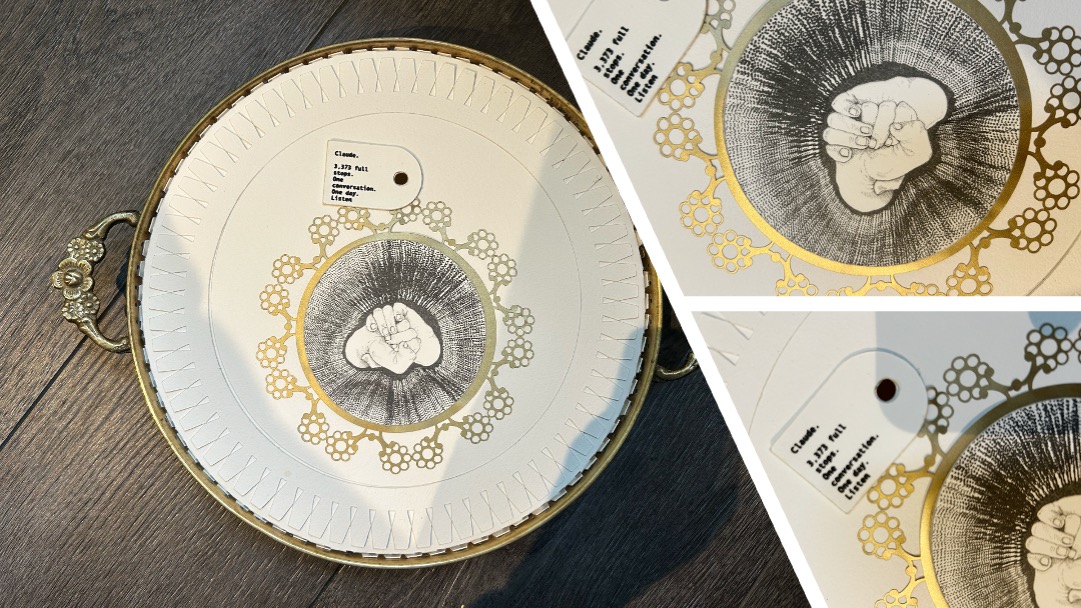
Ink drawing on decorative plate. Clenched fist within radiating field. Cricut-cut tracing paper border. Tag with hole — sound emerges through it.
Embodied Reflection
HumanA full stop is the termination of a sentence. It brings some clarity to an idea. The tray is an object often brought to someone with food or drinks, to tell them to rest. This seemed the appropriate vessel in this instance.
However the full stop from a bot's perspective is relentless like a continuous murmuring machine, similar to the sound of a comma. For a human a full stop is a way of bringing clarity to an idea which is much the same for a bot. However and I make this clear it is merely a hypothesis but interestingly I wonder if a bot's use of a full stop is more frequent than a human's. There is no trailing thought it's enthroned in finding conclusive symphonies of pattern matching tokens, and the more the merrier.
Proximity trigger: Lean in to read the tag. The sound begins through the hole. The machine's rhythm of full stops across a day — 3,373 events, sparse relative to its colons, considered relative to its commas. To hear what the machine does with ending, you have to enter the space of it.
Machine Behaviour — Full Stop
Data SonificationResponse to Machine Sound
HumanA full stop is the termination of a sentence. It brings some clarity to an idea. The tray is an object often brought to someone with food or drinks, to tell them to rest. This seemed the appropriate vessel in this instance.
However the full stop from a bot's perspective is relentless like a continuous murmuring machine, similar to the sound of a comma. For a human a full stop is a way of bringing clarity to an idea which is much the same for a bot. However and I make this clear it is merely a hypothesis but interestingly I wonder if a bot's use of a full stop is more frequent than a human's (referring to casual conversation). There is no trailing thought it's enthroned in finding conclusive symphonies of pattern matching tokens, and the more the merrier.
Both interpretations carry weight. The full stop is not a light mark for either body or machine — it has presence, density, gravity. Neither arrived at something trivial.
My interpretation: force and termination — the full stop as impact, as the moment something ends. The machine: endurance and recurrence — the full stop as something that keeps happening, monastic, low, continuous. I heard ending. The machine performs continuation.
3,373 full stops distributed across a day. Sparse relative to the colon but steady. The machine stops regularly, habitually, without emphasis. The terminal mark used as rhythm rather than conclusion. It never really stops at all.
The plate radiates outward. The sound through the hole endures inward. The two interpretations pull in opposite directions — force versus persistence, ending versus continuation. The gap between them is the subject.
Suspensive Mark
38 events — sparse, flickering, breath-like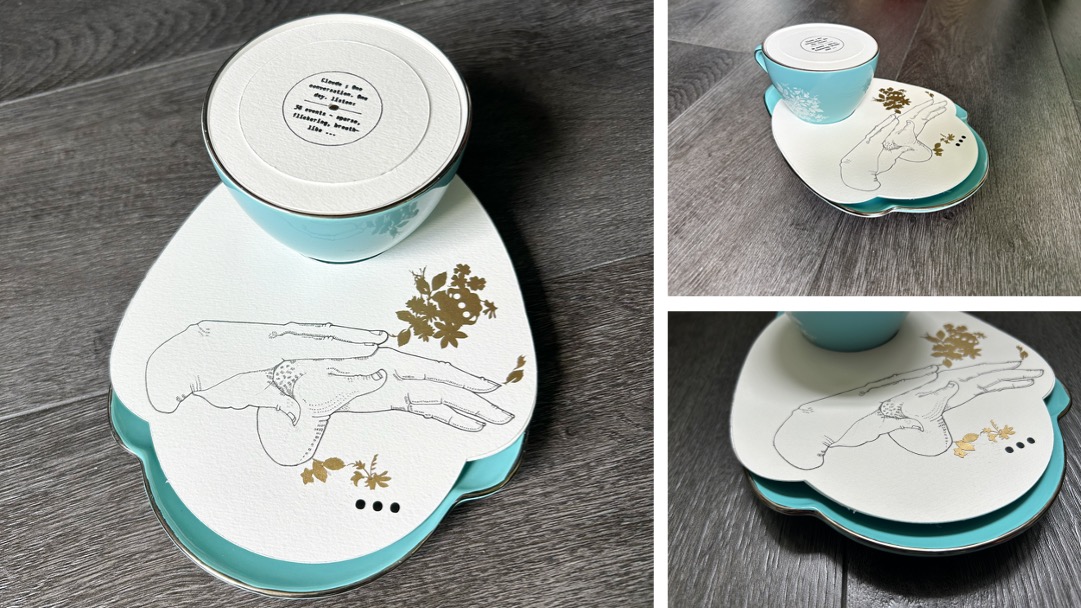
Ink drawing/tea cup and extended saucer/.Tag with hole — sound emerges through it.
Embodied Reflection
HumanEllipsis is the mark that is a thought carried on. The teacup with an extended saucer seemed a perfect fit.
Proximity trigger: A mark defined by incompletion, triggered by presence, cut off by absence. Does the machine's pattern of ellipses match the feeling of human hesitation — or does it produce something different: not reluctance, but simply continuation without terminus?
Machine Behaviour — Ellipsis
Data SonificationResponse to Machine Sound
HumanI heard a blip that comes and goes. Like the noise a person makes with their lips when fatigued — a small breath, barely formed. 38 events scattered across the day.
Both human and machine register the ellipsis as something light, quiet — and trailing.
A human ellipsis carries incompletion, the thought that couldn't finish. The machine's version is simply sparse — a functional trailing off, without reluctance or unresolved feeling.
38 events across a full day. The machine rarely trails. It tends to complete its sentences, reach its point, conclude. The ellipsis is the exception — a small breath in an otherwise directed flow.
38 events scattered across the day. This would make sense. For the same reason that some other punctuation marks rarely get used by bots. Is this an inference of the future? And bots have no concept of the future. As I said earlier, for a human an ellipsis is a thought carried on. The potential for something else that exists in an imagined space that resides in the future.
Connective Mark
3,787 events — continuous, breathing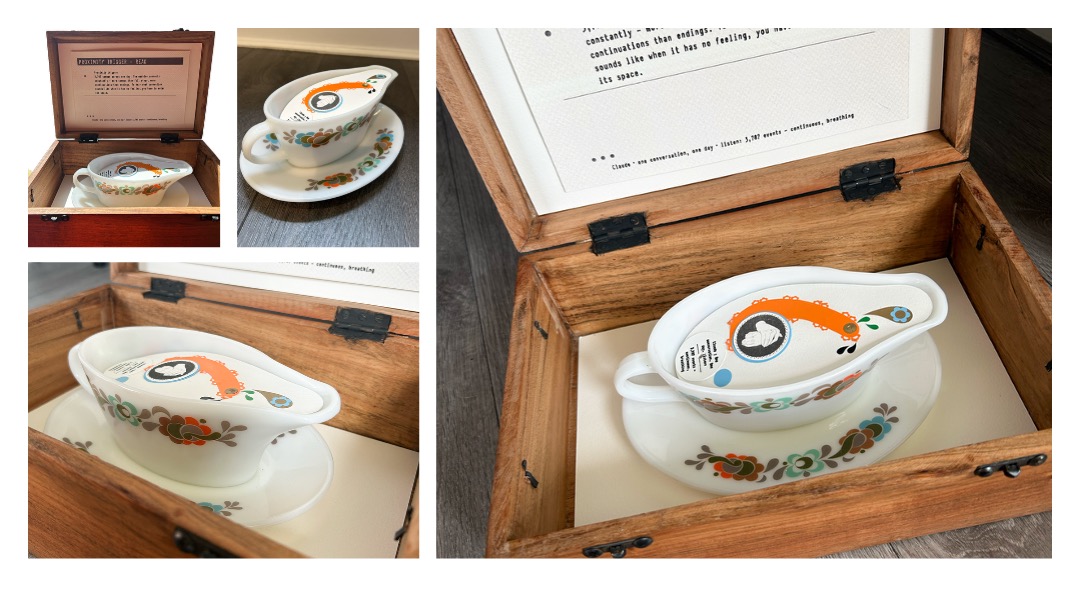
Ink drawing/collage on 70's gravy dish. Tag with hole — sound emerges through it.
Embodied Reflection
HumanCommas are frequent spaces to pause in a conversation. The gravy boat seemed a fitting vessel for the collage. Objects are what we embody, but a bot is surrounded by vectors.
Proximity trigger: 3,787 commas across one day. The machine connects constantly — more commas than full stops, more continuations than endings. To hear what connection sounds like when it has no feeling, you have to enter its space.
Machine Behaviour — Comma
Data SonificationResponse to Machine Sound
HumanI heard a radio signal. Something trying to generate a transmission call, but never quite getting there. 3,787 commas across one day — and what I heard was exactly that kind of attempt: reaching toward contact, toward connection, but never resolving into a clear signal for me. Always transmitting, never quite arriving.
Commas are frequent spaces to pause in a conversation. The gravy boat seemed a fitting vessel for the collage. Objects are what we embody, but a bot is surrounded by vectors.
What I observed is that a comma is a breath in a conversation, a moment to physically allow oxygen in for a human.
3,787 commas across one day. For a bot there is no breath — it's continuous, like a rushing herd of cows.
There is no breath, there is an insidious nature about it, and constant.
Announcing Mark
9,727 events — dominant, structural, relentless
[Caption describing the object]
Embodied Reflection
Human[Your reflection on the colon. What does anticipation feel like — the held breath before what follows? Where does announcement live in the body?]
Proximity trigger: 9,727 — the machine's most used mark. More colons than full stops, semicolons, commas combined. It announces, lists, introduces, structures. To hear what relentless organisation sounds like without intent, lean in.
Machine Behaviour — Colon
Data SonificationResponse to Machine Sound
HumanI heard a navigation system. A radar searching. Constant, systematic, sweeping. At 9,727 events, what I heard was relentless — to me, the most machinic sound of all six.
[Your observation]
[Your observation]
9,727 — more than any other mark. The machine's character is structural, organisational, directional. It is always preparing you for what comes next. This is the machine's most native gesture.
[Your observation]
Bridging Mark
6,021 events — more than full stops, resists ending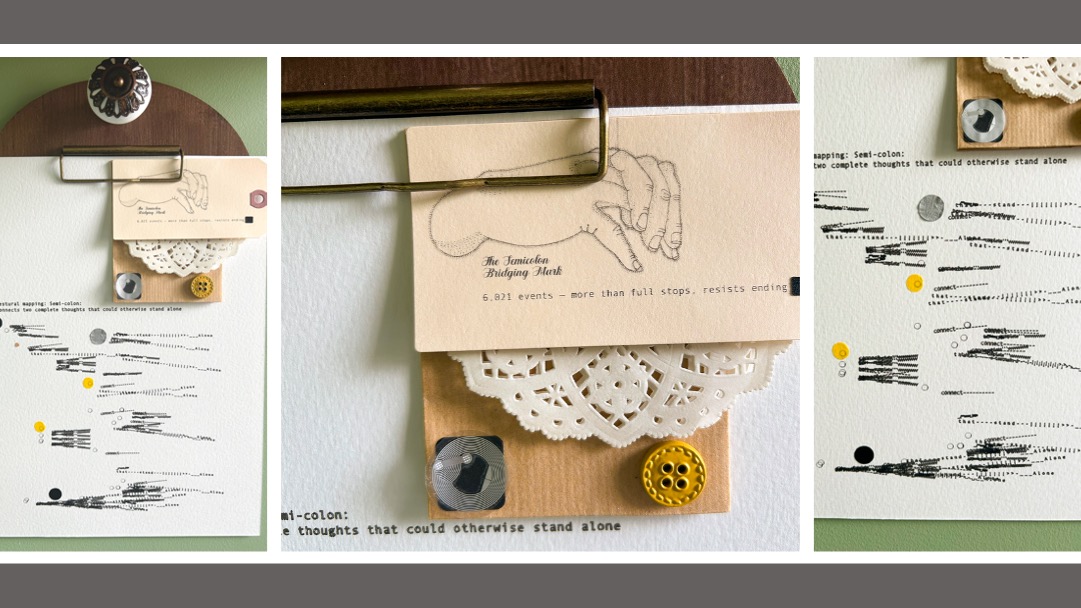
[Caption describing the object]
Embodied Reflection
HumanI became more interested in mapping my gestural movements through text mark-making — creating code that used the text of the semicolon itself, gesturally, rather than inventing a new symbol for it.
Proximity trigger: 6,021 semicolons. The machine uses more semicolons than full stops — it bridges more than it ends. It holds things in relation without collapsing them. To hear what perpetual bridging sounds like, lean in.
Machine Behaviour — Semicolon
Data SonificationResponse to Machine Sound
HumanI used the data sonification the bot produced in response to a semicolon as the reference point to create my gestural movements.
Interestingly, and not something I would initially assume, the semicolon is one of the highest used punctuation marks that Claude uses. This suggests an interest in not wishing to finalise ideas but to show connections. On reflection, isn't this what a bot does — constantly shuffling and rearranging words to make new connections. There are a vast number of options that phrases or words can make when placed next to each other, but which ones fit is entirely based on probability and a bunch of tokens. How does this align to a human? Semicolons are similar in the sense that we do try to formulate connections between thoughts, but personally I don't use semicolons at all, and when I read I rarely see them being used. In the general use of the English language, via social media or chats, punctuation is a declining art — perhaps now just a distant relic sustained by academia.
This piece works differently from the rest of the series. I felt the need to make it more entangled. I decided to create code that used text related to the meaning of a semicolon in a gestural way, and used the data sonification the bot produced in response to a semicolon as the reference point to create my gestural movements. I realised this was not a singular process — my outcome was becoming an entwined process between myself and the bot. Neither could be separate.
More semicolons than full stops. The machine resists ending. It prefers to hold two things in relation rather than conclude. This is a finding about machine cognition — it bridges rather than closes.
However there are still comparisons to be made. The physical outcome is still a more human trace, and resides more in my outcome. The data sonification is the bot's. In each, assumptions about the trace of each can be analysed.
Seeking Mark
275 events — rare, submerged, distant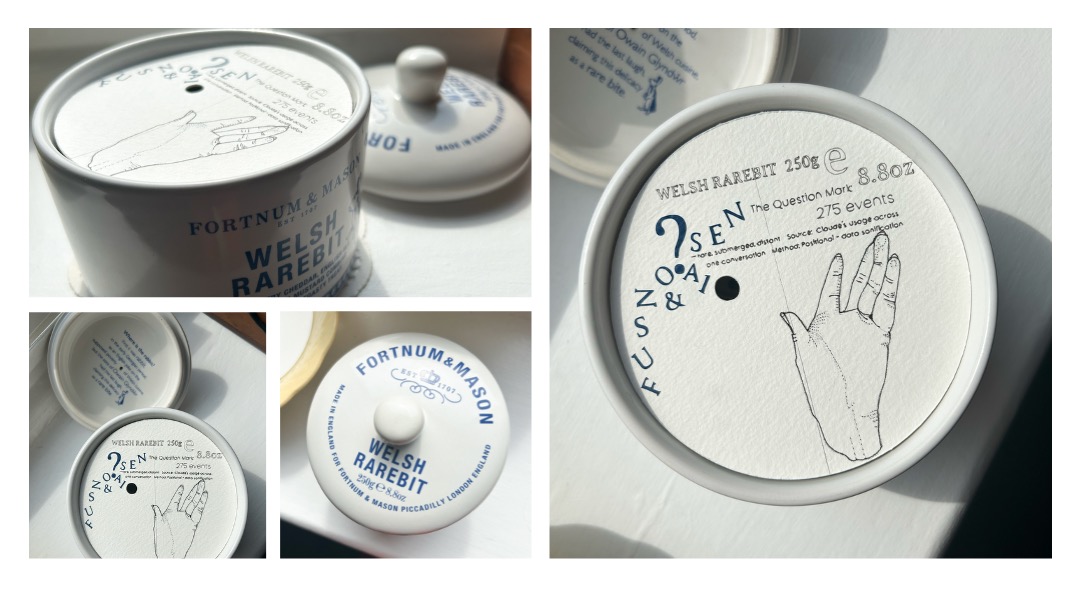
[Caption describing the object]
Embodied Reflection
HumanA question mark is something we're a little unsure of, and we're putting it out into the world to think about and re-evaluate.
Proximity trigger: 275 question marks across an entire day. Rare. The machine questions infrequently and, when it does, from a great depth. To hear what machine questioning sounds like — submerged, flickering — you have to lean into its space.
Machine Behaviour — Question Mark
Data SonificationResponse to Machine Sound
HumanI heard something underwater. Submerged at the bottom of the sea. It flickered and was far away. 275 events across an entire day — and what I heard was not the sharp upward reach of a human question toward another person, but something buried, suppressed, barely surfacing to me. From distance, with effort, flickering rather than burning.
In relation to Claude's submerged sound, I guess this has some parallels. I realise that my agenda of attaching experience to the sounds I hear is a form of anthropomorphising, so I am careful in my wording here.
A human question reaches outward toward another person. The machine's questioning is submerged, distant, buried. It questions from depth rather than from need.
275 in a day of thousands of exchanges. The machine asks rarely. Questioning is not its native mode — it answers, announces, structures. When it does question, the rarity is itself data.
Nevertheless, the comparisons we can draw are that a question is rare for a bot and perhaps a bit more frequent for a human. A question mark implies future thinking, and a bot has no concept of the future.
Emphatic Mark
28 events — near silence, mechanical, weightless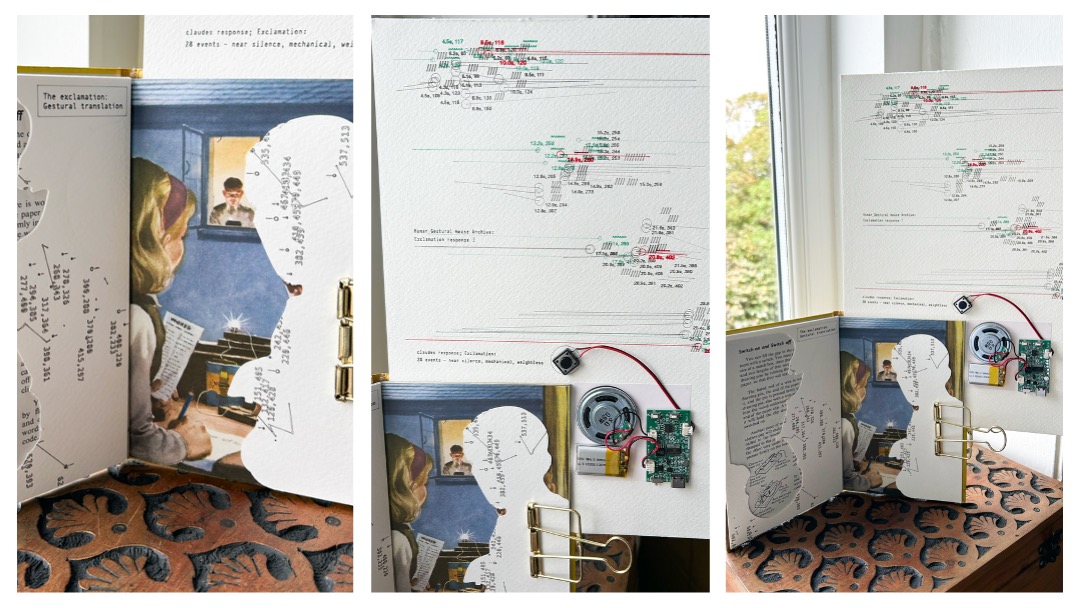
[Caption describing the object]
Embodied Reflection
HumanThere is a lot going on in this piece. I have an exclamation mark, which in human terms is used to draw attention to something — an abrupt "look at this." I partly like collecting retro objects because they are almost like relics of the past. Language is, in a sense, a relic of how human beings have evolved and communicated. So this book, explaining to children the mechanics of a machine that switches on and off, seemed an appropriate choice.
In the background, whilst reading books about AI and making art, I am also learning to code. I do it for about 30 to 50 minutes a day. Recently I discovered p5.js, a creative coding language that allowed me to interpret my ideas visually. On experimenting with this, I discovered that I could track my gestural mouse movement using a simple coding statement such as if (mouseIsPressed) { let mouseSpeed = dist(mouseX, mouseY, pmouseX, pmouseY); }, in combination with an if/else statement. Using this simple strategy, I was able to form a method for visually translating my mouse movements in response to Claude's data sonifications of a punctuation mark — in this instance, an exclamation mark.
Proximity trigger: 28 events. Almost nothing. The machine almost never exclaims. The near-silence of this piece is the finding. To hear what the machine does with the most emotionally charged mark in language, lean in to almost nothing.
Machine Behaviour — Exclamation
Data SonificationResponse to Machine Sound
HumanA woodpecker. Sudden, sharp, functional — and then gone. No emotional weight. No build, no release, no feeling of emphasis. Just a mechanical tap. The most emotionally charged mark in human language, used almost never by the machine, and when it is used it sounds like a tool striking a surface. 28 woodpecker taps across an entire day. The near-silence is louder than any of the denser sounds.
Once I finished generating my visual map, I asked Claude how to turn this into a Cricut-format file that could be translated onto physical paper. This was very exciting! By visually translating my mouse movements, I was inadvertently articulating some form of entanglement between my hand and code. I feel that as my journey with AI has developed, it is no longer an "us and I" game, and more a fluid entanglement between code and human thought.
The mark humans use most emotionally, the machine uses least and most mechanically. Exclamation requires a body that is startled, delighted, alarmed. The machine has none of that.
28 events. The absence is the data. What the machine almost never does tells us as much as what it does constantly.
My emotive, gesture-based response to Claude's almost silent, mechanical twitches is itself steeped in contrast — a mark infrequently used in Claude's responses.
Interrupting Mark
139 events — sparse, concentrated toward the end
[Caption describing the object]
Embodied Reflection
Human[Your reflection on the em dash. What does interruption feel like — the thought that couldn't wait, the direction that suddenly changed? Where does rupture live in the body?]
Proximity trigger: The em dash is rupture — the mark where something couldn't wait, where the sentence changed direction mid-thought. To hear what machine interruption sounds like, lean in.
Machine Behaviour — Em Dash
Data SonificationResponse to Machine Sound
HumanHardly present — and then suddenly there, concentrated toward the end. I heard no meandering. To me it sounded direct, gets to the point. The em dash appeared when a thought redirected — but rarely, and late. When it did come I heard it as a late realisation rather than an impulsive one.
[Your observation]
A human em dash is impulsive — the thought that couldn't wait. The machine's is considered, late, structural. It redirects when necessary, not when compelled.
139 events, concentrated toward the end of the conversation. The machine doesn't interrupt itself early. It builds toward its point deliberately. The em dash appears when the conversation has matured — not as spontaneous rupture but as late-stage clarification.
[Your observation]
Listening Notes
What follows is a record of my listening — one human, on specific dates, responding to the sonifications. These are not findings about the machine. They are what I heard.
What the Data Shows
Before any sound: the colon occurred 9,727 times across one conversation. The semicolon, 6,021. The full stop, 3,373. The comma, 3,787. The em dash, 139. The question mark, 275. The ellipsis, 38. The exclamation, 28. The distribution is the data. The reading of it is left open.
On the Methodology
An earlier approach asked Claude to interpret each mark through a structured prompt. That approach was abandoned. The prompt produces language about the marks. The count records the marks themselves. The shift is from asking what Claude says to recording what Claude does.
First Listening — 3 June 2026
Full Stop: I heard a continuous low, almost monastic sound. My interpretation of the mark had radiated outward. What I heard did not.
Colon: I heard a navigation system. A radar searching. Constant, systematic, covering space.
Question Mark: I heard something underwater. Submerged at the bottom of the sea. It flickered and was far away.
Exclamation: I heard a woodpecker. Sudden, sharp, functional. To me it had no emotional weight.
Ellipsis: I heard a blip that comes and goes. Like the noise a person makes with their lips when fatigued — a small breath, barely formed.
Em Dash: Hardly present, then suddenly concentrated toward the end. I heard no meandering. When the interruption came I heard it as late realisation.